Barsoom's environmental decline
A Princess of MarsBarsoom’s environmental decline is a long, structural crisis rather than a single catastrophe: as seas recede and resources dwindle, life on the planet depends on managed water, artificial atmosphere, and tightly regulated population. The same pressure that drives ingenuity also narrows the margin for survival, helping to explain the planet’s migrations, alliances, labor arrangements, and endemic violence.
A Planet of Diminishing Resources
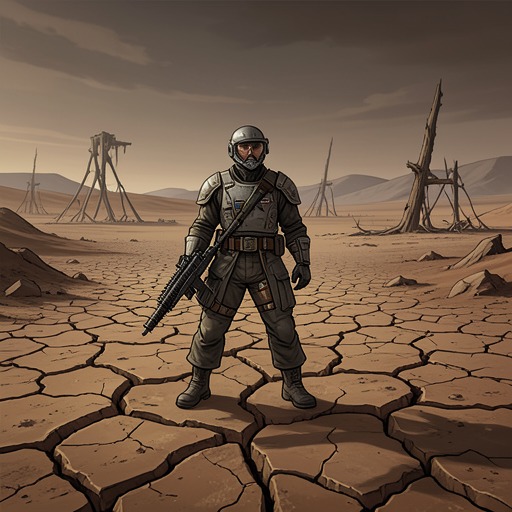
The narrative describes a planet whose natural resources have dwindled until the support of every additional life imposes a cost on its community. The decline is visible in the geography: ancient seas have dried, fertile areas have become comparatively few, and settlements have had to adapt to a world in which habitable land and water cannot be taken for granted. The loss accumulates over ages, not as one sudden disaster, and the novel makes its consequences legible through altered landscapes and institutions.
The remnants of the old coastline preserve that history. Korad, once a center of commerce and culture, stood beside a natural harbor enclosed by hills. By the time Dejah Thoris describes the city, a small valley to its west is all that remains of the harbor; the channel through the hills that once admitted ships leads instead toward the former sea bottom. Similar cities once lined the shores, while lesser settlements converged toward the oceans’ centers as the waters receded. The eventual response was the construction of the Martian canals, a system presented as the people’s means of survival after the loss of the seas.
Water, Food, and Settlement
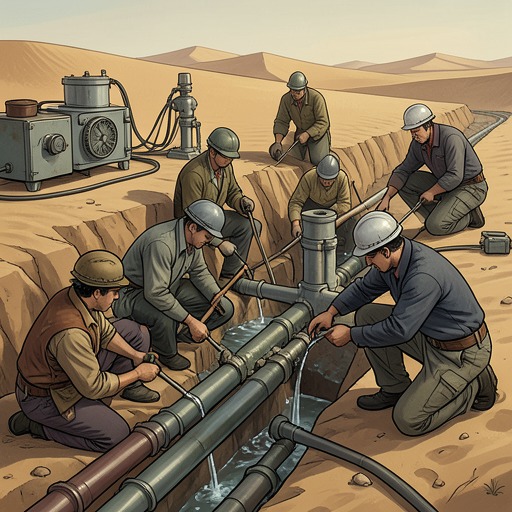
The planet’s agriculture depends on moving water across great distances. Water from melting polar ice caps is gathered in immense underground reservoirs and pumped through long conduits toward populated regions. Cultivated districts extend along those conduits, divided into tracts supervised by government officers. Instead of flooding fields and losing water to evaporation, the system delivers the scarce supply underground through small pipes directly to plant roots.
This infrastructure makes farming possible in a harsh, carefully managed environment. The account describes crops as uniform because the fields are spared drought, rain, high winds, insects, and destructive birds. The system does not mean that scarcity has ended: it shows how much coordination and engineering are required to produce food reliably. Agricultural settlement follows the conduits, while the allotment of land and oversight of each tract connect environmental survival to government administration.
The green Martian community associated with John Carter occupies a broad area of arid and semi-arid land between forty and eighty degrees south latitude, bounded to the east and west by fertile tracts. Its headquarters lie near the crossing of two canals. This geography places the community within a landscape of limited productive zones and engineered water routes, rather than an abundance of freely available resources.
Artificial Air and Planetary Infrastructure
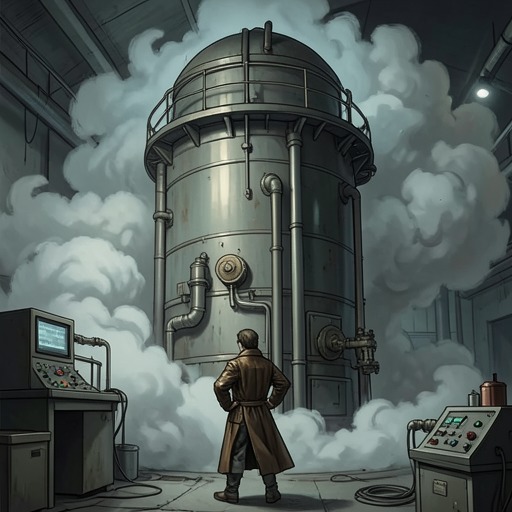
Water is not the only life-support system Barsoom must maintain. The atmosphere itself is produced by machinery in a great building, where the process depends on the ninth ray, separated from sunlight by finely adjusted instruments on the roof. Three-quarters of the building is devoted to reservoirs that store the ray. It is then treated with refined electrical vibrations and pumped to the planet’s five principal air centers; when released, it combines with the ether of space to become atmosphere.
The reserve stored in the building is sufficient to maintain the current atmosphere for a thousand years. Yet this reserve does not make the system invulnerable: the stated danger is an accident to the pumping apparatus. The distinction is consequential. Barsoom’s survival depends not only on possessing stored resources but also on keeping the machinery that distributes them functioning. The atmosphere plant makes the planet’s environmental crisis concrete as a technological and institutional responsibility, with planetary life resting on an engineered process that cannot simply be abandoned.
Population, Conflict, and Adaptation
Environmental scarcity also shapes population policy. The novel links dwindling resources to a system of careful selection and birth-rate regulation, designed to produce only enough births to offset deaths. The narrator presents this as a response to the costs of sustaining additional lives on a dying planet. It is an austere form of social management: ecological pressure is translated into decisions about which lives are permitted to enter the community and how the population is maintained.
The same pressure bears on mortality. After maturity, the average Martian life expectancy is about three hundred years; the narrator argues it would approach a thousand were it not for the many paths to violent death. Only a small fraction die of sickness or disease, while many die in duels, hunting, aviation, and war; childhood also brings substantial losses to the great white apes of Mars. The account connects this high mortality and the casual regard for life to the planet’s declining resources, alongside dangerous sports and nearly continuous warfare among communities. Environmental stress is not offered as the sole cause of violence, but as part of the conditions under which violence becomes normalized.
Alliances and the Meaning of Survival
The drying seas forced the higher Martian peoples into alliance. They sought the few remaining fertile areas and had to defend themselves, under altered conditions of life, against the green Martians. Over time, intermarriage among these groups produced the red Martian race. The account also describes cultural loss amid hardship and continual warfare: much of the earlier civilization and its arts disappeared as people adapted to the changed world, and the ancient archives, records, and literature were largely lost.
Dejah Thoris presents the scientific work of her people as serving a shared planetary need. Her expedition had been sent to rechart air currents and take atmospheric-density measurements, and she argues that maintaining the air and water supply benefits both red and green Martians. Her appeal to the green warriors imagines cooperation as a way to help regenerate the planet. The scene makes the environmental crisis a political question as well as a technical one: survival requires systems for air and water, but their long-term value depends on whether communities can overcome hostility and act together. The novel’s account therefore holds two realities in view—the remarkable ingenuity that keeps Barsoom habitable and the destructive rivalries that continually threaten the people who depend on it.